
Youth Soccer Training in Dallas: Ages & Programs
Updated: 5 days ago
Searching for youth soccer training in Dallas can feel like comparing very different experiences. Some programs are built around a fun first touch, some focus on technical progress, and others prepare committed players for competitive club soccer. The right choice depends on your player's age, current experience, goals, schedule, and readiness for a more demanding environment.
Book a free first session with Foro Skills to see which age- and level-appropriate training path fits your player.
What should youth soccer training in Dallas provide?
Youth soccer training in Dallas should give players an age-appropriate way to improve technical skills, decision-making, confidence, and game understanding. Strong programs also explain where a player can go next, from foundational classes to advanced training, goalkeeper development, private coaching, or a competitive club pathway.
That definition matters because "training" can describe a weekly recreational class, a technical skills session, a team practice, a goalkeeper clinic, a private lesson, or a high-performance program. These formats can complement one another, but they do not solve the same problem.
Before choosing a program, answer three questions:
What does the player enjoy most about soccer right now?
What specific improvement would make the biggest difference over the next season?
Does the player want a fun development environment, more structured competition, or a pathway toward higher-level play?
A good program should welcome an honest answer. A beginner should not be pushed into a high-pressure setting simply because it sounds elite. An ambitious player should not be held in a group that never challenges decision-making or speed of play. The best fit is the one that creates consistent practice, useful feedback, and a clear reason to return.
Which age group is right for a Dallas youth soccer program?
The right age group is the one that matches the player's development stage, not just the year on a birth certificate. Younger players generally need fun, repetition, coordination, and comfort with the ball. Teen players often benefit from faster decisions, more tactical context, and training that connects technical work to competition.
Ages 5 to 8: Build comfort and curiosity
For a young player, the first goal is a positive relationship with the ball and the game. Sessions should include frequent touches, simple dribbling and stopping activities, changes of direction, short games, and chances to make choices. Coaches should keep explanations clear and let children learn through movement rather than long lines or lectures.
At this stage, parents can look for:
Small-group activities with plenty of ball contact.
Games that make movement and teamwork enjoyable.
Coaches who can redirect attention without discouraging mistakes.
A welcoming environment for beginners and returning players.
Foro Skills organizes foundational youth classes for players ages 5 to 13. Its age and skill groupings are designed to keep early training approachable while developing the essential skills needed to play and enjoy soccer.
Ages 9 to 12: Connect skills to decisions
Players in this range can usually handle more purposeful technical challenges. A strong session still needs energy and variety, but it can ask players to scan, choose a pass, protect the ball, change speed, and respond to what is happening around them. Training should help a player understand why a technique is useful, not only how to perform it in isolation.
Ask whether the program gives players opportunities to:
Use both feet in realistic situations.
Receive the ball while moving and under pressure.
Recognize space and support teammates.
Repeat a skill and then use it in a small-sided game.
This is also a useful point to identify a player's interests. Some children become excited by attacking play, others by defending, passing, creating, or goalkeeping. Good coaching can expose them to different roles without forcing an early permanent position.
Ages 13 to 17: Increase speed, intensity, and purpose
Teen players often need training that respects their desire to improve while meeting them at their current level. A beginner may need to strengthen fundamentals and confidence. An experienced player may need faster technical execution, more demanding decisions, and better habits between actions. The same age range can include very different starting points.
Foro Skills offers soccer training for players ages 13 to 17, from beginners to advanced athletes. The program focuses on skills, strategy, and fitness in a fast-paced environment. Players who are ready to explore that format can review the teen training program and use a free assessment or first session to identify a suitable starting point.
The most useful teen program is not necessarily the one with the hardest workout. It is the one that makes intensity purposeful, connects training to match situations, and gives the player feedback they can apply in the next session or game.
What types of youth soccer training are available in Dallas?
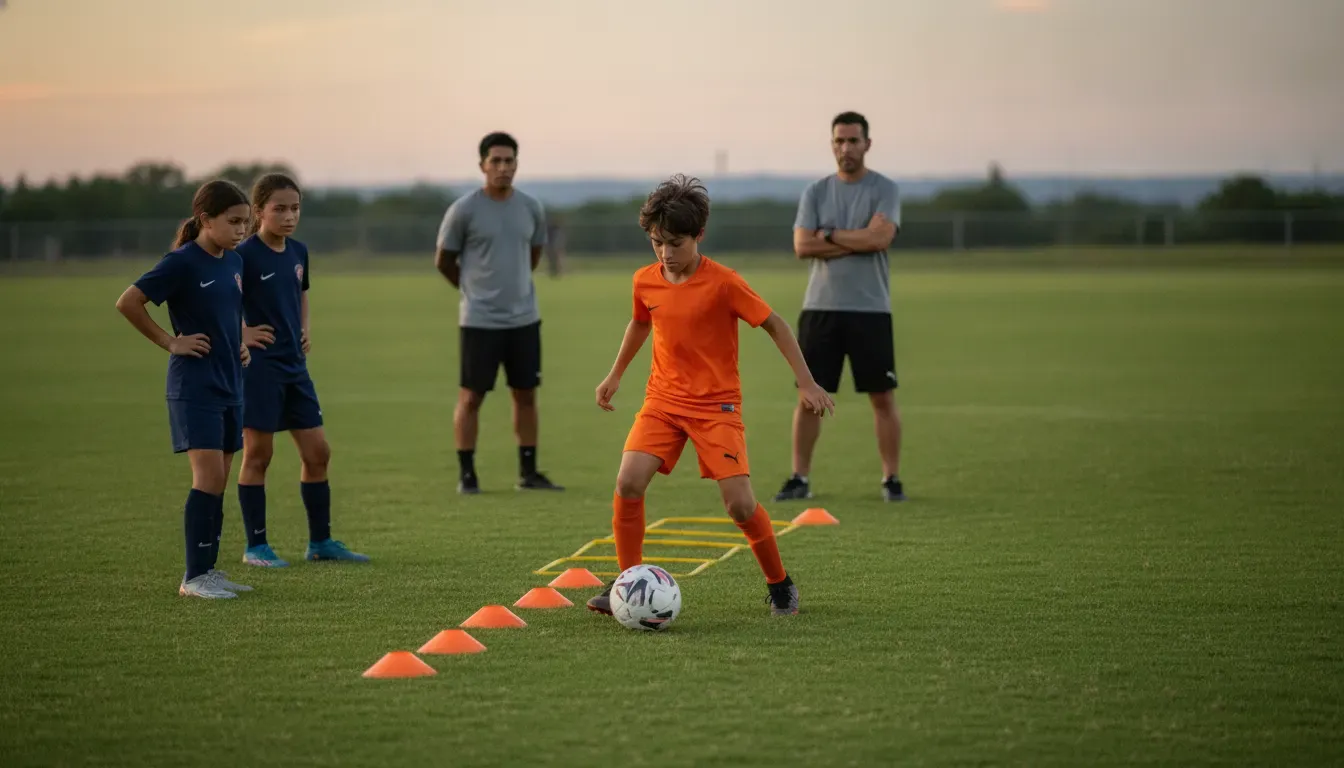
Dallas families can choose among several youth soccer training formats, including foundational classes, technical training, goalkeeper clinics, private sessions, small-group work, camps, and competitive club programs. Each format serves a different purpose, so compare the learning environment and next step rather than choosing based on a label alone.
Program type | Best fit | What to look for |
Foundational classes | Players ages 5 to 13 building confidence and core skills | Age grouping, frequent touches, games, and patient coaching |
Technical training | Players ages 13 to 17 who want more pace and challenge | Skills linked to decisions, strategy, fitness, and match situations |
Goalkeeper clinics | Players ages 5 to 17 who want position-specific development | Handling, footwork, shot-stopping, positioning, and game awareness |
Private training | Players with a specific personal goal or technical need | Individual feedback, a clear focus, and a plan that fits the player |
Club training | Players pursuing regular team competition and a longer pathway | Coaching quality, training commitment, competition, and communication |
Performance training | Players who want optional fitness and athletic development support | Athlete-appropriate progressions that complement soccer training |
This comparison is a starting point, not a ranking. A goalkeeper may need both a weekly team environment and specialized goalkeeper work. A player who is new to the sport may benefit from classes before deciding whether club competition is appealing. A teenager preparing for a higher level may combine technical training with team play and optional performance support.
How do foundational classes help younger players?
Foundational soccer classes help younger players build comfort with the ball, basic coordination, and confidence in a group. The best sessions balance repetition with play. Players should practice dribbling, passing, shooting, and teamwork, then have chances to use those skills in simple games that reward movement and problem-solving.
Parents often focus on whether a child scored during a session. A better early question is whether the child became more willing to receive the ball, try a move, use space, or participate with teammates. Progress can look like a player who stays engaged longer, tries a new foot, or asks to come back next week.
Foro Skills serves ages 5 to 13 through classes divided into age groups such as U6/U8, U9/U10, and U11/U12. Families can see the class options and ask about the best group for a player's age and experience. The program is designed for all skill levels, which is important when siblings or classmates arrive with different backgrounds.
When evaluating any class, observe the ratio of active learning to waiting. Young players should spend much of the session moving, touching the ball, and interacting with teammates. A coach's ability to make a correction quickly and positively is often more valuable than a complicated drill.
When should a player consider competitive soccer training?
A player may be ready for competitive soccer training when they want a greater challenge, can handle consistent practice, and are willing to learn from mistakes. Readiness is not defined by age alone. Motivation, attendance, emotional maturity, athletic development, and the quality of the environment all matter.
Signs that a player may be ready for a more competitive pathway include:
The player asks for more difficult practices or opponents.
The player can stay engaged through a structured session.
The player wants feedback and can try it again after a mistake.
The family can support the training and competition schedule.
The player understands that development includes both strengths and weaknesses.
Competitive does not have to mean constant pressure. It should mean a higher level of focus, clearer standards, and more meaningful opportunities to apply skills. Parents should ask how coaches communicate expectations, how players are grouped, and how the program supports athletes who are still developing.
Foro Soccer Club provides a seasonal option for players aspiring to compete at the college or professional level. The club pathway includes daily training with Foro SC under Michel Garbini, personalized recruiting files, and professionally edited highlight videos, according to the club's program description. Families interested in that direction can learn about Foro Soccer Club and ask which next step matches the player's age and goals.
What should parents look for in a youth soccer coach?
A strong youth soccer coach can teach the game clearly, adapt to different players, and create an environment where effort and attention matter. Look for coaches who demonstrate the skill, explain the purpose, give specific feedback, and keep players active. Playing experience can add credibility, but teaching ability and age-appropriate communication are just as important.
1. A clear coaching method
Ask what the session is intended to improve. A good answer might mention receiving under pressure, changing direction, supporting the ball, or making a decision in a small-sided game. A vague promise to make every player "better" is less useful than a coach who can explain the learning objective.
2. Feedback the player can use
Useful feedback is specific and timely. Instead of only saying "good job" or "work harder," a coach might help a player open their body before receiving, look up before passing, or slow down to control the next touch. The player should leave knowing what to try next.
3. A positive response to mistakes
Soccer requires risk. Players need to try a move, pass into space, or make a decision before they know whether it will work. Coaches should hold players accountable without using embarrassment as a teaching tool. Confidence and standards can exist together.
4. Experience that fits the program
Foro Skills describes its coaches as player-coaches who actively play or have played at a high level. That perspective can help players connect training to real soccer, especially when the coach explains how a technique or habit appears in a game.
5. A realistic next step
The coach should be able to say what the player can work on next, whether that is attending a class consistently, trying a goalkeeper clinic, adding focused individual work, or exploring a club evaluation. Development should feel like a process, not a single judgment.
Should a player add goalkeeper, private, or performance training?
Specialized training can be useful when it solves a specific development need. Goalkeeper clinics support players who want position-specific work. Private training can provide focused feedback. Optional performance training can support athletic qualities such as speed and agility. None should replace a healthy, age-appropriate soccer environment or be treated as mandatory.
Goalkeeper training: Foro Skills offers goalkeeper clinics for ages 5 to 17 that focus on shot-stopping, agility, and game awareness, with handling and footwork included in the training description. A player does not need to be certain about becoming a goalkeeper to try a specialized session. Exposure can help a young athlete learn what the position requires.
Private training: One-on-one sessions make the most sense when a player has a defined goal, such as improving a first touch, preparing for a position, or building confidence in a specific action. Foro Skills' private training program emphasizes personalized attention, tailored drills, strategic insight, and detailed feedback. Families should ask how the coach will measure progress and how the work connects to team play.
Performance training: Fitness work should complement soccer rather than turn every session into a conditioning test. Foro Skills identifies FPA Performance and pro fitness training through EXOS as optional programs. A player can discuss whether that type of support is appropriate after the core soccer goal is clear.
For families comparing options, start with the need. If the player needs more confidence with the ball, a general class or technical session may be the right first move. If the need is position-specific, a clinic may be more useful. If the player wants an individualized plan, private training may fit. Explore the clinic options before deciding.
How can Dallas families compare youth soccer programs?
Compare youth soccer programs by fit, not by the biggest claims. Review the age groups, skill levels, coaching approach, schedule, facility, competition, communication, and next step. Then let the player experience a session when possible. A clear fit is more valuable than a program that sounds impressive but does not match the player's needs.
Use this checklist during a call, visit, or trial session:
- Age and level:
Are players grouped in a way that supports learning and confidence?
- Learning objective:
What will the player practice and why does it matter?
- Active time:
Will the player spend most of the session moving and touching the ball?
- Coaching:
Can the coach explain corrections in language the player understands?
- Environment:
Does the setting feel positive, organized, and appropriately challenging?
- Schedule:
Can the family attend consistently without creating avoidable stress?
- Competition:
If the player wants competition, how does the program create that opportunity?
- Progress:
How will the family know what the player is working toward next?
- Facility:
Is the training space suitable for the age group and session format?
- First step:
Is there a clear way to experience the program before making a longer commitment?
Do not judge a session only by how advanced the drills look. A simple activity can be excellent if players are making decisions, receiving useful feedback, and staying active. Conversely, a complex drill can be a poor fit if players spend most of the time waiting or do not understand its purpose.
Start with a free session at Foro Skills and use the experience to ask better questions about your player's next training step.
What makes Foro Skills a Dallas option for youth development?
Foro Skills combines age-based youth classes, teen soccer training, specialized clinics, and a connection to the Foro Soccer Club pathway at one Dallas facility. The model is designed to support a player's progression from first touches and foundational skills to more advanced training and competitive goals.
The program operates at Foro Sports Club, a 13-acre multi-sport complex at 14719 Preston Road, Dallas, Texas 75254. The location is in North Dallas near Preston Road and Belt Line Road. Families can contact Foro Skills with questions about age groups, schedules, and the most appropriate entry point.
Foro's youth options include:
Classes for ages 5 to 13 that emphasize essential skills, teamwork, and enjoyment.
Training for ages 13 to 17 focused on skills, strategy, fitness, and a fast-paced environment.
Goalkeeper clinics for players who want specialized work on the position.
Groups, clinics, camps, and other programs for different development needs.
A seasonal Foro Soccer Club pathway for players pursuing college or professional opportunities.
Foro Soccer Club's documented achievements include 10 conference championships, the 2021 UPSL national championship, four national-final appearances, and victories over professional clubs in the Lamar Hunt U.S. Open Cup. The club also connects its development pathway to 18 players and coaches who reached the professional level. Those facts describe the broader pathway, not a promise that every youth participant will reach the professional game.
That distinction is important. The right youth program should meet the player where they are now and support the next realistic step. A young beginner does not need to be marketed a professional outcome. A committed teen should be able to ask what training and competition opportunities exist beyond the basics.
How should a player get started with youth soccer training in Dallas?
The simplest way to start is to choose one clear goal, book an introductory experience, and use the coach's feedback to select the right program. Families do not need to solve an entire soccer pathway on day one. They need enough information to make the next session useful and sustainable.
- Write down the goal.
Is the priority fun, confidence, foundational skill, position work, competitive preparation, or a higher-level pathway?
- Match the age and level.
Begin with the class or training group designed for the player's current stage, not an idealized future level.
- Ask about the session.
Confirm what players work on, how groups are formed, and what to bring.
- Watch the player's response.
Look for engagement, effort, curiosity, and willingness to try again after mistakes.
- Set one next target.
After the session, choose one habit to repeat at the next practice or game.
Foro Skills invites Dallas-area players to begin with a free first session or evaluation, depending on the program. You can request a free session, then discuss whether classes, teen training, a clinic, or another program is the best fit.
Consistency matters more than a single exciting session. A player who attends regularly, receives useful coaching, and enjoys the environment has a better foundation for long-term improvement than a player who moves from program to program without a clear goal.
Frequently asked questions about youth soccer training in Dallas
Families usually make better decisions when they compare the player's age, goals, experience, schedule, and preferred learning environment. The answers below provide a starting point, but a coach should confirm the most appropriate group after learning more about the player.
What age can a child start soccer training in Dallas?
Children can begin with age-appropriate soccer classes when they are ready to participate in a group and follow simple instructions. Foro Skills offers foundational classes for ages 5 to 13. For younger players, prioritize fun, movement, ball contact, and a supportive coaching environment over advanced tactics.
Is youth soccer training only for advanced players?
No. A well-designed program should have an entry point for beginners as well as challenges for experienced players. Foro Skills describes both its classes and its ages 13 to 17 training as open to all skill levels, from beginners through advanced athletes.
What soccer training is available for teenagers in Dallas?
Teen players can look for technical training that combines skills, strategy, fitness, and game-realistic decisions. Foro Skills offers training for ages 13 to 17 and connects eligible players with a broader competitive pathway through Foro Soccer Club.
Does a youth soccer program need to include club competition?
Not always. Some players need foundational classes or technical development before deciding whether they want competition. Players who are ready for a longer competitive commitment should ask about team structure, training expectations, competition, communication, and the next evaluation or tryout step.
Should my player try goalkeeper training?
Goalkeeper training can help a player who already enjoys the position or wants to explore it. Specialized sessions should cover handling, footwork, agility, shot-stopping, positioning, and game awareness. Foro Skills offers goalkeeper clinics for ages 5 to 17 and welcomes players at different skill levels.
How do I choose the best youth soccer training program in Dallas?
Choose the program that matches the player's age, current level, goals, schedule, and preferred learning environment. Ask what players will practice, how coaches give feedback, how groups are formed, and what the next step is. An introductory session can help confirm whether the fit feels right.
Ready to compare your next step? Book a free first session with Foro Skills in Dallas and start with a program matched to your player's age and goals.


Comments